As Christians, we take seriously what the Bible says about how we should live—and this includes how we should dress, adorn, and present ourselves. Three NT passages (1 Corinthians 11, 1 Timothy 2, and 1 Peter 3) specifically mention how Christians should or should not wear their hair. In the King James Version, 1 Timothy 2:9-10 reads, “In like manner also, that women adorn themselves in modest apparel, with shamefacedness and sobriety; not with broided hair, or gold, or pearls, or costly array; but (which becometh women professing godliness) with good works.”
In this post I want to focus specifically on the meaning of the phrase “broided hair.” Broided is a word that we no longer use in contemporary English; consequently there is the potential for this word to inadvertently cause confusion. Of course, someone reading 1 Tim 2:9-10 in a modern translation will not be tripped up by this antiquated term. But the KJV is still a popular translation, and many Christians read the KJV exclusively; so this term deserves some attention.
If we misunderstand the meaning of broided, we will unintentionally twist the scripture to mean something it doesn’t actually say. Worse, if we explain or apply this verse on the basis of our misunderstanding, we will inadvertently teach others an error instead of biblical truth.
One misunderstanding of broided
While there may be others, I am familiar with at least one misunderstanding of the word broided. I have encountered this misunderstanding multiple times in multiple situations (e.g., conversations, sermons), and I myself have been guilty of repeating this error without doing sufficient research. In a sense, this article is a sort of apology; I regret that I have told others something untrue about the Bible and I want to set the record straight.
The error I have encountered is that broided and braided mean two different things: whereas braided refers to weaving the hair on itself, broided refers specifically to weaving gold, silver, jewels, or other ornaments into the hair.


This interpretation of broided feels intuitive for several reasons. For one thing, the word broided feels unfamiliar and foreign, because most people have never encountered it outside the Bible; unlike braided, which is an ordinary word in every day speech. Since the word is outside of our common experience, it is natural to assume that it refers to a practice which is equally uncommon.
For another thing, broided sounds similar to embroider—and so it makes sense that broided would mean adding ornaments to the hair, just like embroidery involves adding colorful thread to a fabric. This association can be compounded by contemporary English dictionaries. Merriam-Webster’s dictionary does not contain the word broided; but it does contain the word broider, which it defines as embroider.1 For another thing, it is true that wealthy women in antiquity would adorn their hair with jewelry. If someone knows this, it is easy to assume that this is what Paul meant by the term broided in 1 Tim 2:9-10.2
But all this is a misunderstanding. Broided does not specifically refer to weaving ornaments into the hair. Rather, broided is merely an old spelling for our ordinary word braided. In what follows I will provide evidence that broided and braided are merely two forms of the same word.
Of vowels and Pre-Modern English
The spelling difference between broided and braided might feel strange, but English performs vowel shifts like this all the time.3 Take the verb sing as an example. Sing, sang, and sung are all the same word—but the spelling changes depending on how the verb is being used. The same could be said for run/ran and win/won. Vowel changes like this are a common part of English grammar, and this is what is going on with broided. According to the Oxford English Dictionary (OED), the past participle of the verb braid used to be broiden in older dialects of English; broiden, in turn, produced the forms broid and broided. As far back as Middle English (1100-1500 AD), broid was simply a variant spelling for braid; the earliest example listed in the OED is from around 1250.4
In the Early Modern period (1500-1700), when the KJV was translated, it seems that English was only just beginning to use braided as the adjectival form of braid;5 but broided was still most commonly used. We can actually see this transition starting to occur in English Bible translations prior to the KJV.6
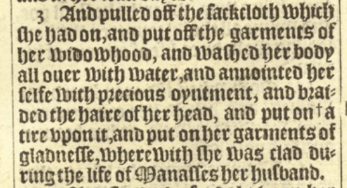
In the apocryphal book Judith 10:3, the Coverdale Bible (1535), the Great Bible (1541), and the Bishop’s Bible (1568) say that Judith “broided and platted her hair;” but the KJV (1611) says that Judith “braided the hair of her head.”
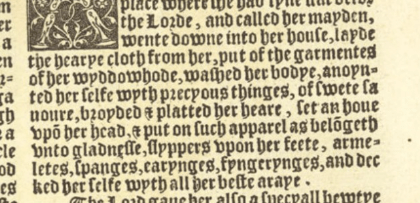
In this very passage, 1 Tim 2:9-10, the KJV and most pre-KJV translations say “broided hair;” but the Bishop’s Bible says “braided hair.”
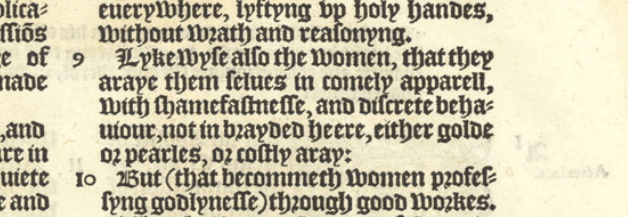
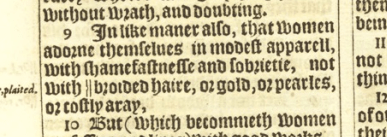
In short, when the KJV says broided, it isn’t referring to anything out of the ordinary. Broided was simply the common spelling for braided at this time in history. As I said before, Merriam-Webster’s dictionary doesn’t contain the word broided—but it does contain the word broid, which it defines as an “obsolete variant of braid.” In the mid-1500s and early 1600s, braided was only just beginning to be spelled in its modern form. Eventually braided became the common spelling and broided fell out of use. But broided and braided are, fundamentally, two different spellings of the same word; “broided hair” and “braided hair” are the same thing.
Modern versions and the Greek original
Although a few translations prefer the less literal rendering “elaborate hairstyles” (e.g., CSB, ISV, NIV), most modern English versions translate 1 Tim 2:9 as “braided hair” (e.g., ESV, LSB, NASB, NET, NKJV, NRSV). The relevant Greek term here, πλέγμα, describes anything that is woven, twisted, or braided together. In extra-biblical literature, πλέγμα is used to describe things like wicker baskets or nets; 1 Tim 2:9 is the only time it is used in the NT. This noun comes from the verb πλέκω, which likewise indicates braiding or weaving. The gospels use this verb to describe the Roman soldiers platting Jesus’s crown of thorns (Mt 27:29, Mk 15:17, John 19:2).
So it seems that 1 Tim 2:9 is describing any weaving or twisting of the hair—anything ranging from a simple braid to more elaborate fashioning. But πλέγμα, as a word, carries no implication of weaving ornaments into the hair.
Bill Mounce has suggested that 1 Tim 2:9-10 does describe weaving ornaments into the hair, but his argument is not based on the word braided/broided/πλέγμα but on other grammatical factors in the verse. Mounce points out that, in the NA/UBS edition of the Greek NT, 1 Tim 2:9 says μὴ ἐν πλέγμασιν καὶ χρυσίῳ ἢ μαργαρίταις “not with braided hair and gold or pearls.” According to Mounce, the “and” indicates that Paul does not forbid a plain braid but rather a braid with jewelry woven in: the problem is not “a braid” but “a braid and.”7 It may be the case that Paul specifically forbids bejeweled braids in 1 Tim 2:9; but Mounce’s argument is inconclusive for two reasons.
Firstly, πλέγμασιν καὶ / “braided hair and” is a textual variant. The “and” / καὶ has early attestation (Sinaiticus, Alexandrinus, and the Peshitta Syriac & Coptic versions); but the majority of Greek manuscripts, the Latin Vulgate, the Harclean Syriac, and Clement of Alexandria support “or” / ἤ. We do not possess any papyri manuscripts which contain this section of 1 Timothy.8 I can see good arguments for favoring either reading, depending on whether a person thinks the original reading is more likely to be found with the oldest manuscripts or with the majority of manuscripts. But it is unwise to build an argument almost entirely on a textual variant which is not firmly settled.
Secondly, even if πλέγμασιν καὶ / “braided hair and” is the genuine reading, this still would not necessarily prove Mounce’s conclusion—depending on where one places the sense break.
- “braided hair and gold or pearls /// or costly clothes”—If this is where the sense break falls, Paul is condemning bejeweled braids and expensive clothing. This is how Mounce understands the grammar. If this is the correct interpretation, Paul is not discussing braiding in general or jewelry in general, but only gold and pearls woven into the hair.
- “braided hair /// and gold or pearls or costly clothes”—If this where the sense break falls, Paul condemns braiding without specifying any particular type of braid, as well as gold, pearls, and expensive clothing. If this is the correct interpretation, Paul is discussing braiding in general (i.e., hair woven on itself) as well as jewelry (regardless of where it is worn on the body).
Again, I can see good arguments for understanding the passage either way; though I lean toward the latter interpretation. Since “and” / καὶ may or may not be the original reading—and even if it is, it does not require us to understand Paul as referring to bejeweled braids—Mounce’s argument is unconvincing.
But to repeat: even if Mounce’s argument is correct and Paul really is discussing jewelry woven into the hair, this is due to other grammatical features in the passage—not to the inherent meaning of the Greek word πλέγμα or the English word broided. Both of these words simply mean “braid,” and ordinarily refer to an unadorned braid (i.e., the hair woven on itself).
Conclusion
The purpose of this article is not to advocate for a particular application of 1 Tim 2:9-10. In other words, this article does not take a position on whether Paul totally forbids all braiding or whether women can braid their hair provided it is not ostentatious. My goal in this article is more fundamental than that. Before we can determine how to properly obey 1 Tim 2:9-10, we must first understand what the passage actually says; and that is my purpose here.
Regardless of how a person applies this passage, 1 Tim 2:9-10 refers to “braided hair.” This is what the relevant Greek word means; this is what broided meant in 1611; and this is how most modern English translations render the passage. When we say that broided, by definition, refers specifically to weaving ornaments into the hair, we are misinterpreting the passage by misunderstanding an antiquated spelling we no longer use. Broided hair is one and the same with braided hair.
- See here. ↩︎
- For an example of an article which contains several of these misapprehensions, see here. ↩︎
- Vowel shifting like this is not unique to English; this sort of thing also happens in Greek, Latin, German, and many other languages besides. ↩︎
- Oxford English Dictionary, “broid (v.), Etymology,” May 2025, https://doi.org/10.1093/OED/7280070703.
Oxford English Dictionary, “broiden (adj.), Etymology,” May 2025, https://doi.org/10.1093/OED/8751045590. ↩︎ - Oxford English Dictionary, “braided (adj.), sense a,” May 2025, https://doi.org/10.1093/OED/8404397781. ↩︎
- High resolution scans of these Reformation-era Bibles can be found here. ↩︎
- Mounce has a detailed treatment of his view in his commentary Pastoral Epistles, Word Biblical Commentary 46 (Thomas Nelson, 2000); but he has made the same argument on his blog (see here). ↩︎
- As of May 2025. For a list of NT papyri see here. ↩︎
 Lectionary
thank you for this information, I really needed it. I haven’t read everything but I screenshot everything so that when I have time then I will read everything. But I’m greatful for information and most definitely I will follow the Author. Thank you once again.
LikeLiked by 1 person
Thank you for reading! Glad it was a blessing!
LikeLike