One of the most glorious truths of scripture is that Jesus of Nazareth—a Jewish man who had a mother, siblings, and friends, who ate, slept, and drank, and who put on his shoes one at a time just like anyone else—is also somehow the Creator who brought everything that exists into existence. Many biblical passages testify to Jesus’s status as Creator; in this post I want to work through some of them, to help solidify this doctrine in the heart of my readers. It is not a trivial thing to recognize and worship Jesus as the Creator, but it is a crucial aspect of the Christian faith.
Among other things, Jesus’s status as Creator of all things also proves that he is divine: Jehovah repeatedly says that he created all things alone and by himself (e.g., Isa 44:24). So, if Jesus is the Creator, then he is also the one God. Some will object, however, that the Bible does not teach that Jesus is the Creator—but rather that Christ himself is a creature. Such people would argue that Jesus is not the Creator God, but is himself a part of creation: perhaps the first one, perhaps the most glorious one, but still a created being. Both sides of this debate agree that there is only one God (Deut 6:4) and that this one God is the eternal, uncreated Creator. The issue is whether Jesus is that Creator—or something made by that Creator.
Of course it is true that Jesus is a creature in this sense: namely, that he took upon himself a created human nature when he became incarnate in the womb of Mary and was made man. But prior to this incarnation Jesus was not Jehovah’s first and greatest creation: rather, Jesus is the Creator Jehovah God himself, as the scriptures plainly attest.
I now turn my attention to some biblical passages which affirm that Jesus is the Creator. Along the way I will also answer some potential objections to this scriptural doctrine.
Hebrews 1:6-12
Hebrews 1 lays out Jesus’s unique and preeminent status as God’s Son by contrasting him with the angels, who are often called “sons of God” elsewhere in scripture (Gen 6:1-4, Job 1:6, 2:1, 38:7, Ps 29:1). This Son of God is different from every other son of God. The author of Hebrews makes this contrast by quoting various passages of the Old Testament as if God the Father were saying them, either to angels or to his Son. The Father speaks to the angels as if they are powerful but created,1 serving,2 and worshipping beings.3 The way the Father speaks to and about his Son is entirely different. Three OT references in Hebrews 1 should catch our attention.
Firstly, in Hebrews 1:6 the Father speaks to the angels about his Son. Quoting Psalm 97:7, the Father commands the angels to worship his Son: “And again, when he bringeth in the firstbegotten into the world, he saith, And let all the angels of God worship him.” Unlike the angels who give worship, this verse says that the Son receives worship. Furthermore, this verse commands the angels to give the Son a particular type of worship.
In its original context, Ps 97:7 was written as worship to God Almighty: Jehovah is King (97:1), Jehovah is the Lord of the whole earth (97:5), the heavens declare Jehovah’s righteousness, and every nation sees Jehovah’s glory (97:6). Jehovah is high above the earth and exalted above every other god (97:9). In v. 7, these lesser gods, the angels, are commanded to worship Jehovah. The words of Ps. 97:7 are divine worship intended for Jehovah; as such, it would be blasphemous idolatry to apply these words to any mere creature. No created thing can validly accept divine worship: to give these words to a created thing would be to “give Jehovah’s glory to another” (Isa 42:8).
And yet the Father speaks the words of Ps 97:7 to the angels about his Son. The Father commands the angels to give his Son divine worship, which only belongs to Jehovah alone. If Jesus is only a created thing, it would make no sense for the Father to order the angels, “Worship this mere creature, who is not God, as if he is Jehovah God himself. Give him worship that rightfully belongs to me alone.” This is clear proof that Jesus is God; otherwise, the Father would be instructing the angels to commit the sin of idolatry.
Secondly, in Hebrews 1:8 the Father speaks directly to the Son. Quoting Psalm 45:6, the Father addresses the Son as God: “Thy throne, O God, is for ever and ever: the sceptre of thy kingdom is a right sceptre.” Some versions mistranslate this verse as “Your throne is God,” instead of the correct translation “Your throne, O God.” Elsewhere (here and here) I have demonstrated that the Greek grammar requires “O God” as the proper translation. Not only does the Father command the angels to divinely worship the Son as God almighty, but the Father himself calls the Son “God.”
Thirdly, in Hebrews 1:10-12 the Father again speaks directly to the Son. Quoting Ps 102:25-27, the Father refers to his Son as Jehovah God who created all things: “Thou, Lord, in the beginning hast laid the foundation of the earth; and the heavens are the works of thine hands: they shall perish; but thou remainest; and they all shall wax old as doth a garment; and as a vesture shalt thou fold them up, and they shall be changed: but thou art the same, and thy years shall not fail.”
Again, in its original context Ps 102 is divine worship of Jehovah as God. Jehovah will endure forever (102:12) and from his heavenly sanctuary Jehovah looks down on the earth (102:19). The author of this psalm says that Jehovah afflicted him (102:23); and so the psalmist cries out to Jehovah for mercy: “O my God, take me not away in the midst of my days: thy years are throughout all generations” (102:24). The psalm-writer continues speaking to Jehovah in vv. 25-27 where he says that Jehovah created heaven and earth (25), but Jehovah will remain long after this world has worn out like an old shirt (26) because Jehovah, unlike heaven and earth, is eternal (27). Ps 102 is worship that rightly belongs to God the Creator alone.
And yet, the Father speaks the words of Ps 102:25-27 to his Son. Again, this makes no sense if Jesus is only a creature. Even if we said that God created Jesus first, and then Jesus created everything else on God’s behalf, this still a) wouldn’t make Jesus the Creator God and b) wouldn’t make Jesus worthy of divine worship. Ps 102 worships Jehovah as Creator; and the Father clearly applies these words to the Son. Thus, the Father himself refers to his Son as Jehovah the Creator.
Using key quotations from the Old Testament, the author of Hebrews clearly calls Jesus God, offers Jesus divine worship as God, and acknowledges Jesus as Jehovah who created all things. In spite of these clear statements in Hebrews 1, some still believe that Jesus is not God but merely a part of God’s creation. Colossians 1 and Revelation 3 are two passages often cited as proof of Jesus’s creaturely status; but this is a misunderstanding. When these verses are properly understood, they both actually affirm Jesus’s status as the creator God.
Colossians 1:12-18
Much of the book of Colossians is dedicated to showing Jesus’s preeminence over all things (1:18). As part of this larger aim, Paul describes Jesus as the creator of all things: “For by him all things were created, in heaven and on earth, visible and invisible, whether thrones or dominions or rulers or authorities—all things were created through him and for him. And he is before all things, and in him all things hold together” (1:16-17 ESV). Notice that Paul does not limit Jesus’s status as creator to merely physical or earthly things. Jesus is not only the creator of things on earth, but also things in heaven; he did not merely create the visible universe, but he also created invisible spiritual realities. Jesus even created relational structures like dominions or governments. Paul’s list is exhaustive: everything that was ever created (τὰ πάντα), Jesus created it.
Lest anyone miss the point, Paul emphasizes that Jesus existed prior to any created thing (αὐτός ἐστιν πρὸ πάντων) and that Jesus holds all creation together (which is reminiscent of Heb 1:1-3). The meaning of this passage is clear: Jesus is the pre-existent Creator who made all things and holds all things together. Paul’s clarity notwithstanding, some still use this passage to argue that Jesus is not the creator but is instead himself a creature.
One way that some cloud the clarity of this passage is by adding words which are not in the original Greek text. For example, instead of saying that Jesus created all things and exists before all things, the Jehovah’s Witnesses New World Translation says that Jesus created all other things and existed before all other things. This makes it sound as if Jesus is himself a created thing: Jehovah created Jesus first, and then used Jesus to create everything else.
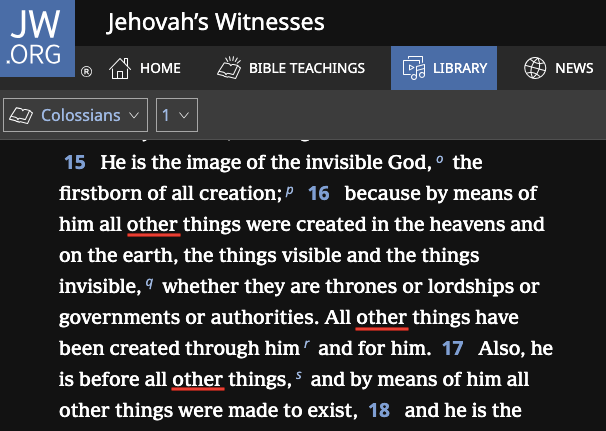
The Greek language has two different words for “other.” The term ἄλλος implies “another of the same kind.” If I used ἄλλος in the phrase “another tree,” I would be talking about another tree of the same kind—two oaks, two maples, two sycamores, and so forth. The term ἕτερος, on the other hand, implies “another of a different kind.” If I used ἕτερος in the phrase “another tree,” I would be talking about another tree of a different kind—an oak and a maple, a maple and a sycamore, and so forth.
If the apostle Paul had written τὰ ἄλλα πάντα, this would imply that Jesus was another created thing in the same category as every other created thing: Jesus is a creature just like everything else, the same type of creature as everything else. Such a wording would be strong evidence that Paul considered Jesus as only a part of creation. If Paul had written τὰ ἕτερα πάντα, this would imply that Jesus was a created thing—but in a different category from every other creature. If the JW claim were true, that Jesus is God’s first and greatest creation, τὰ ἕτερα πάντα is the wording that we would expect to see.
There’s just one problem: neither ἄλλος nor ἕτερος occur in Colossians 1:15-18. Even the JW’s Kingdom Interlinear shows that these words are not present in the underlying Greek—and leaves out the word “other” when translating the passage literally.
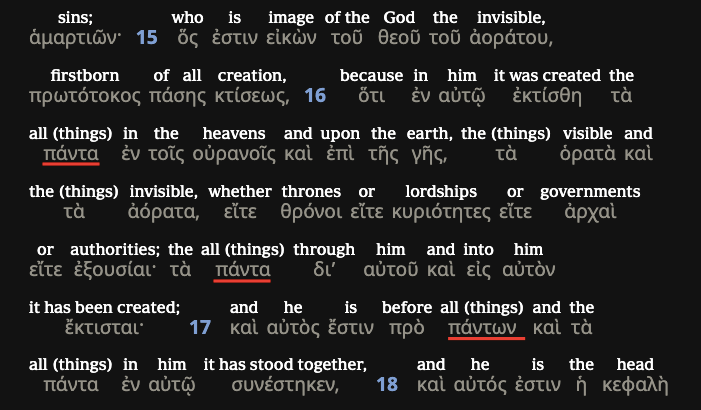
Paul clearly says that Jesus existed prior to, and created, all things—not all other things. This means that Jesus cannot merely be a creature. Jesus isn’t a “created thing,” because he existed before all created things. Jesus isn’t a “created thing,” because Jesus created all created things. Jesus can’t be the creator and a mere created thing at the same time: this would mean that he created himself, which is obviously nonsensical. Since Jesus created all things, he must be Jehovah the creator God.
Another way that people “twist this scripture to their own destruction” (2 Peter 3:16) is by misunderstanding the preposition διά in this passage. At the end of Colossians 1:16, Paul says τὰ πάντα δι᾽ αὐτοῦ…ἔκτισται. Depending on which translation a person consults, this phrase is translated “all things were created by him” (KJV) or “all things were created through him” (most modern versions).
The misunderstanding of διά goes something like this: “The preposition διά implies intermediate agency, not ultimate agency. In other words, διά means that a person is performing an action through or by means of something else. We see this in verses like Acts 2:43 or Acts 14:3 where the Bible says “many wonders and signs were done through the apostles” (διὰ τῶν ἀποστόλων) or “through their hands” (διὰ τῶν χειρῶν αὐτῶν). Obviously the apostles were only men; there was nothing magical about their hands. They weren’t really the ones doing these miracles; God was the one performing the miracles through them. They were just tools. It is the same in Colossians 1. Jesus isn’t ultimately the one who created all things; like the apostles, Jesus is only a tool or a means. Jehovah created all things through Jesus: this means that Jesus isn’t really Jehovah the creator himself.” But this way of thinking is mistaken.
Although it is true that διά can imply intermediate agency, this is not the only meaning of the word. Often διά indicates “one who is the author of the action as well as its instrument, or of the efficient cause,”4 “with focus on the originator of an action.”5 We see this in verses like Matt 18:7 where Jesus says, ” Woe to that man by whom (δι᾽ οὗ) the offense cometh.” This verse isn’t talking about a situation where Person A uses Person B to offend; rather, only one person is the author, originator, and cause of the offense. In other words, the person through whom the offense comes is the person who does the offending.”
The NT frequently uses διά to describe actions which God performs:
- Rom 11:36 For from him and through him (δι᾽ αὐτοῦ) and to him are all things (τὰ πάντα). To him be glory forever. Amen. (ESV)
- 1 Cor 1:9 God is faithful, by whom (δι᾽ οὗ) you were called into the fellowship of his Son, Jesus Christ our Lord. (ESV)
- Heb 2:10 For in bringing many sons and daughters to glory, it was entirely appropriate that God — for whom and through whom all things exist (δι᾽ οὗ τὰ πάντα)— should make the pioneer of their salvation perfect through sufferings. (CSB)
- Heb 7:21 For those priests were made without an oath; but [Christ] with an oath by him that said (διὰ τοῦ λέγοντος) unto him, The Lord sware and will not repent, Thou art a priest for ever after the order of Melchisedec: (KJV)
In every one of these examples where διά is used, God is the ultimate agent: he is the originator of the action and the one who brings the action about. More specifically, the NT describes God’s role in creation with the preposition διά twice—in Rom 11:36 and Heb 2:10. Obviously this does not mean that someone else was using God as a tool or a means to bring creation about. All things were created “through God,” but this doesn’t mean that there was someone else creating “through him.” God alone is creator.
In both of these instances where God’s creative work is described, Paul and the author of Hebrews use the words δι᾽ αὐτοῦ τὰ πάντα. This should catch our attention, because these are the exact words that Paul uses in Col 1:16 when he says that all things were created by Christ (τὰ πάντα δι᾽ αὐτοῦ). Rom 11:36 is especially relevant, because it describes God with the expanded phrase “through him, and to him, are all things” (δι᾽ αὐτοῦ καὶ εἰς αὐτὸν τὰ πάντα); the same Greek wording is used in Col 1:16 with respect to Christ, “all things were created by him and for him” (τὰ πάντα δι᾽ αὐτοῦ καὶ εἰς αὐτὸν).
Paul (and the author of Hebrews) describes God’s role in creation and Christ’s role in creation in identical terms: both are described as the one δι᾽ οὗ all things were created. Therefore, it cannot be assumed that Christ was an intermediate agent in creation simply because of the preposition διά. A better explanation is that Christ is God: Christ is the creator, and thus God and Christ can both be described as the one “by / through whom” creation came to exist
One more way that people misinterpret this passage is by misunderstanding the phrase “firstborn / πρωτότοκος of creation” in Colossians 1:15. This error results from conceiving of the term “firstborn” in an overly-human way. The assumption is that Jesus is “the firstborn of creation” in exactly the same way that Esau was the firstborn of Isaac, or that Reuben was the firstborn of Jacob—but this need not be the case.
Of course, there are many times in scripture where the term “firstborn” straightforwardly means “a person’s first child.” But there are also times in scripture when the title “firstborn” is metaphorical / non-literal and refers to a special place of exalted authority and dignity. In Exodus 4:22 God tells Pharaoh “Israel is my son, even my firstborn (πρωτότοκος),” even though Israel was not the first nation to ever exist. The title “firstborn” here refers to Israel’s unique covenantal relationship with Jehovah—not their status as the first country God ever created.
In Jeremiah 31:9 the title “firstborn” is even more metaphorical: “I am a father to Israel, and Ephraim is my firstborn (πρωτότοκος).” Notice that Ephraim is the one called the firstborn here. On a strictly literal reading, this statement is nonsense. For one thing, the tribe of Ephraim is a part of the nation of Israel—how could a part be “firstborn” over the whole? For another thing, Ephraim-the-person was the grandson of Israel-the-person (i.e., Jacob)—how could a grandson be “firstborn” before his grandfather? And still again, Ephraim wasn’t even the firstborn son of Joseph—Manasseh was the physical firstborn (Genesis 41:51-52). “Firstborn” is a completely inappropriate title for Ephraim, physically speaking; and yet God calls Ephraim “firstborn” because of the special relationship God had with this tribe.6
King David, himself a type of the Messiah, is called “firstborn” in Psalm 89:27: “I will make him my firstborn (πρωτότοκος), higher than the kings of the earth” (see v. 20). Again, on a literal reading, this does not make sense: David was not the firstborn son of his father Jesse, nor was he the first king of Israel. The second half of the verse is a Hebrew parallelism, explaining the first:7 David is called firstborn because God has exalted him “higher than the kings of the earth.” David is firstborn, not literally, but in terms of exalted rulership over others.
The title “firstborn” is likewise metaphorical in Colossians 1:15. This verse is not teaching that Jesus is the first thing ever created: as we have already seen, this passage refers to him as the Creator. Instead, this verse is teaching that Jesus holds an exalted place of authority over all creation.
Revelation 3:14
Another verse which many misunderstand as teaching that Jesus is a mere creature is Revelation 3:14, which calls Jesus “the beginning of the creation of God.” At first glance, this verse would seem to support such a view: God is the creator, and Jesus is the start of God’s creation—the first thing God ever created. When we look deeper at this verse, however, we see that this is not what John intended.
Normally, when we say “the beginning of” something, the “beginning” of a thing is part of that thing. For example, the morning is “the beginning of” the day; and the morning is part of the day. So, when we read that Jesus is “the beginning of” creation, it is natural assume that Jesus is part of creation. But when we look at the full range of meanings for ἀρχή—the Greek term translated as “beginning” in this verse—we see that Revelation 3:14 definitely does not teach that Jesus is God’s first creation.
On the one hand, ἀρχή often means “origin” or “source.”8 Indeed, some versions translate Revelation 3:14 along these lines (e.g., Berean Standard Bible, CEV, CSB, NASB2020, NET, NRSV). When we understand ἀρχή in this way, we see that Revelation 3:14 is not calling Jesus a mere creature. This verse is actually calling Jesus the Creator: he is the originator of creation, he is creation’s source, he brings creation into existence. This harmonizes with what we have seen earlier—that by Christ “all things were made.” As Creator, Jesus is the source / origin of existence for every created thing.
On the other hand, ἀρχή frequently refers to “power” or “sovereignty,” an office of “authority,” or a “magistrate”—i.e., a “ruler.”9 This is a common meaning for ἀρχή in the New Testament.
- Rom 8:38-39 For I am sure that neither death nor life, nor angels nor rulers (ἀρχαὶ),…will be able to separate us from the love of God in Christ Jesus our Lord. (ESV)
- 1 Cor 15:24 Then comes the end, when he delivers the kingdom to God the Father after destroying every rule (πᾶσαν ἀρχὴν) and every authority and power. (ESV)
- Titus 3:1 Remind them to be submissive to rulers (ἀρχαῖς) and authorities, to be obedient, to be ready for every good work (ESV)
- See also Eph 1:21, 3:10, 6:12; Col 1:16, 1:18, 2:10, & 2:15.
Not only is the “ruler / authority” definition of ἀρχή well established in NT usage, but it is strengthened by a verbal parallel in Revelation 1:5.
- Rev 1:5 the faithful witness, and the first begotten of the dead, and the prince of the kings of the earth
ὁ μάρτυς ὁ πιστός ὁ πρωτότοκος ἐκ τῶν νεκρῶν καὶ ὁ ἄρχων τῶν βασιλέων τῆς γῆς - Rev 3:14 the faithful and true witness, the beginning of the creation of God
ὁ μάρτυς ὁ πιστὸς καὶ ἀληθινός ἡ ἀρχὴ τῆς κτίσεως τοῦ θεοῦ
Both of these verses refer to Jesus as “the faithful witness.” Both verses situate Jesus in a relationship to the material world (the earth / God’s creation). Revelation 1:5 calls Jesus the “prince” / ἄρχων, and 3:14 calls him the “beginning” / ἀρχή. Even if you don’t know Greek, you can see that these two words share the same αρχ* root. This verbal parallel strongly suggests that we are supposed to understand “beginning” / ἀρχή in the context of rulership or authority10—especially since “prince” / ἄρχων comes first, prepping us for how to interpret “beginning” / ἀρχή later in the discourse.
Furthermore, multiple times in the book of Revelation God applies the term ἀρχή to himself: in 21:6 and 22:13 (and arguably 1:811), God refers to himself as “the beginning and the end” / ἡ ἀρχὴ καὶ τὸ τέλος.
In sum, the phrase “the beginning of the creation of God” could mean a) that Jesus is the origin or source of creation—i.e., the Creator; or b) that Jesus is the “ruler” or “sovereign authority” over creation. But in neither case does it mean that Jesus is a mere creature.
Conclusion
It is a wonderful thing to think of Jesus as the Lord God our Creator. When we pray to Jesus, we are not speaking to a mere man—no matter how highly exalted and glorified. When we worship Jesus, we are not merely honoring a fellow-creature—older than us, but one of us—Jehovah’s “first and greatest creation,” but only a creation still.
No, no. When we come to Jesus, we are coming to God himself—the Creator who is before all things, who made all things, and who upholds all things. There is not one single creature in existence which Jesus did not make, and make for himself. Jesus is our Creator and our Lord, worthy of our worship and adoration. In our times of devotion, we would do well to praise Jesus for his status as Creator and to thank him for creating us and revealing himself to us.
Isaiah 64:8—But now, O LORD, thou art our father; we are the clay, and thou our potter; and we all are the work of thy hand.
Revelation 4:11—Thou art worthy, O Lord, to receive glory and honour and power: for thou hast created all things, and for thy pleasure they are and were created.
- Heb 1:7 shows that the angels are created by describing God as Ὁ ποιῶν τοὺς ἀγγέλους αὐτοῦ. The verb ποιέω should catch our attention; cf. Gen 1:1LXX, ἐν ἀρχῇ ἐποίησεν ὁ θεὸς τὸν οὐρανὸν καὶ τὴν γῆν. ↩︎
- Heb 1:14 ↩︎
- Heb 1:6 = Ps 97:7 (96:7LXX); cf. Deut 32:43LXX ↩︎
- Joseph H. Thayer, Greek English Lexicon of the New Testament (Peabody: Hendrickson, 2012) s.v. διά, 133. ↩︎
- BDAG s.v. διά, 225. ↩︎
- Resulting, perhaps, from Jacob’s preferential blessing of the patriarch Ephraim in Genesis 48. ↩︎
- In Hebrew poetry, it is common to say the same thing in two slightly different ways. E.g., Ps 24:1 “The earth is the LORD’S, and the fulness thereof; the world, and they that dwell therein.” In this verse, “earth” and “world” are essentially the same concept—just as “the fulness of the earth” and “those who dwell in the world” are. Keep an eye out for this pattern in the Bible, and it will greatly increase your understanding of scripture. ↩︎
- LSJ, s.v. ἀρχή. ↩︎
- LSJ, s.v. ἀρχή II. The NIV follows this definition, translating Revelation 3:14 as “the ruler of God’s creation. ↩︎
- See footnote 7 above on the importance of parallelism. ↩︎
- The TR of 1:8 says ἀρχὴ καὶ τέλος, without the definite articles. ↩︎
 Lectionary
Yes ! Jesus is God Amen! Even says Jesus is the bright and morning star yet to Lucifer it’s stated how art thou fallen son of the morning these two scriptures says that the bright and morning star is the Father / Creator of Lucifer 🕊️🙏❤️
LikeLiked by 1 person
I don’t think I would call Jesus “the Father of Lucifer”—but he is definitely Lucifer’s creator and God.
LikeLike
The only reason why I say Father is because Lucifer is the Son of the morning and God did create him as well 🕊️🙏❤️
LikeLike
sublime! Robot Barista Opens Café in Tech Hub City 2025 chic
LikeLiked by 1 person